Preventing Operational Stress Injuries. Supporting Healing. Building Hope.

Our mission is to bring first responders, frontline workers, families, people with lived experience, healthcare and mental-health professionals, peer supporters, researchers, educators, legal professionals, organizations and decision-makers together to create meaningful change.
We believe that meaningful change requires more than treating the consequences of operational stress injuries. We must also work toward prevention and understand the organizational, workplace and systemic factors that contribute to these injuries in the first place.
Through collaboration, education, research and the sharing of lived experience, we aim to identify gaps, learn from what is already working, challenge what is not, and explore better approaches to prevention, early intervention, healing, family support and long-term recovery.
We also intend to create opportunities for constructive dialogue with organizations, government agencies, elected representatives and other decision-makers to explore improvements to policies, practices, legislation and systems that affect the health and wellbeing of frontline personnel and their families.
Our long-term vision is to create and support New Hope Field of Dreams locations—holistic family sanctuaries where people can find opportunities for healing, connection, peer support, education, recreation and family rebuilding.
We believe people should not have to navigate this journey alone.
By bringing the right people and resources to the same table, we hope to reduce stigma, strengthen families, prevent operational stress injuries from becoming life-altering or life-threatening, reduce suicide and help create healthier, safer communities.
The mission comes first. The people come first.
MAKING COMMUNITIES SAFER ACROSS ONTARIO — AND ULTIMATELY ACROSS CANADA.
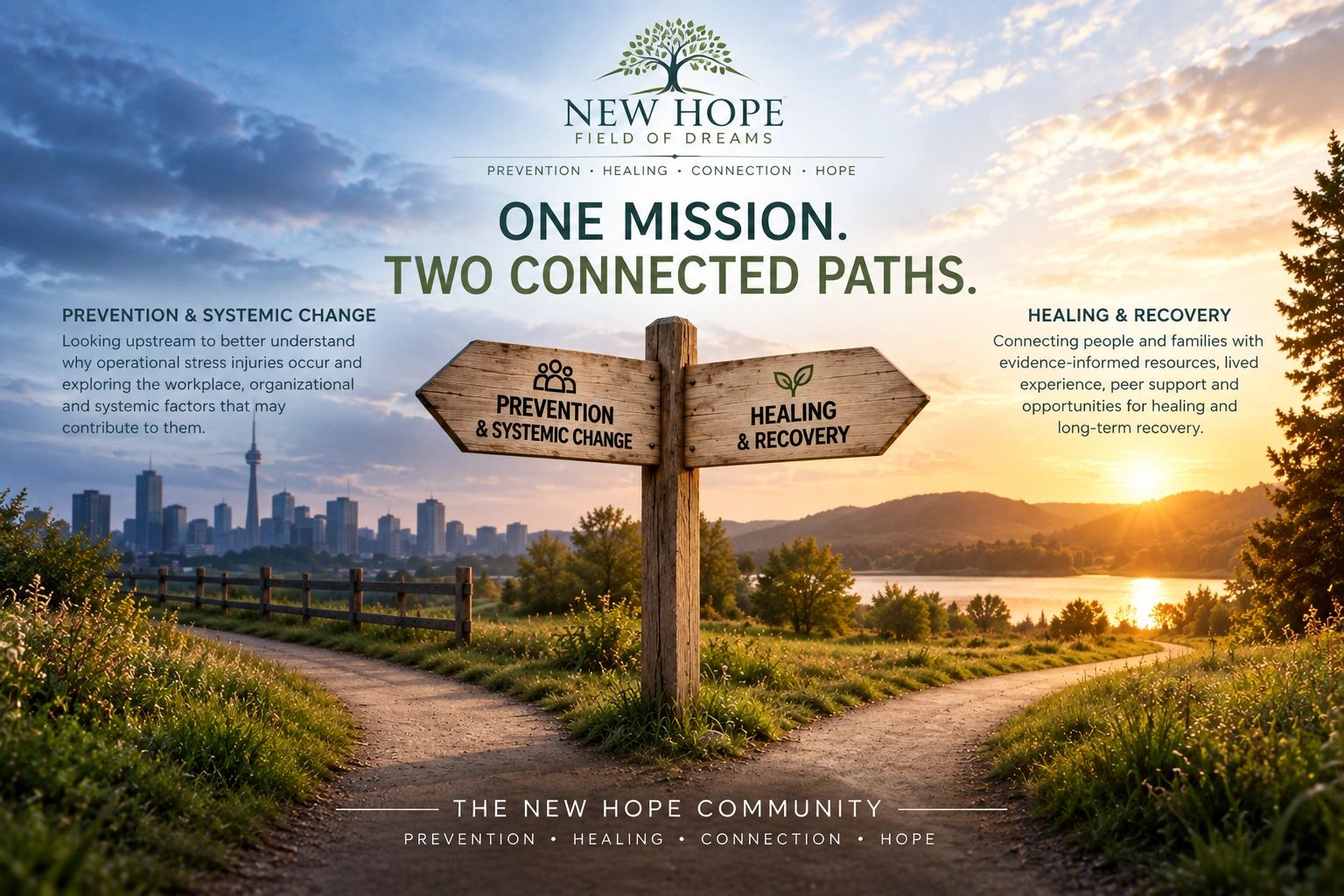
Preventing operational stress injuries and supporting those already affected require different approaches—but they are part of the same mission.
Looking upstream to better understand why operational stress injuries occur and exploring the workplace, organizational and systemic factors that may contribute to them.
Through lived experience, research and collaboration, we want to identify what is working, where gaps exist, and where changes to practices, policies, procedures, regulations or legislation could help prevent injuries before they occur.
For those already affected, we want to explore and connect evidence-informed resources, clinical expertise, lived experience, peer support, family support and complementary approaches that can contribute to healing and long-term recovery.
The New Hope Community brings both sides of this conversation to the same table.
New Hope Field of Dreams is the physical sanctuary component of that larger vision, focused on healing, connection, family support and long-term recovery.

No single person, profession, organization or system has all the answers.
The New Hope Community brings together first responders, frontline workers, families, people with lived experience, healthcare and mental-health professionals, peer supporters, researchers, educators, legal professionals, organizations, government and other stakehold
No single person, profession, organization or system has all the answers.
The New Hope Community brings together first responders, frontline workers, families, people with lived experience, healthcare and mental-health professionals, peer supporters, researchers, educators, legal professionals, organizations, government and other stakeholders to share knowledge and learn from one another.
Our goal is to identify gaps, learn from what is already working and explore practical solutions that can improve prevention, healing, family support and long-term recovery.
We believe many of the pieces already exist. What is often missing is the connection between people, resources, knowledge and systems.
By bringing those pieces together, we can build something greater than any one person or organization could create alone.
That is all I would change right now.
We envision a connected approach where existing knowledge, resources, services and expertise work together rather than operating in isolation.
No single treatment, program or approach will meet the needs of every person or family.
By connecting clinical expertise, lived experience, peer support, research, education, family support and compl
We envision a connected approach where existing knowledge, resources, services and expertise work together rather than operating in isolation.
No single treatment, program or approach will meet the needs of every person or family.
By connecting clinical expertise, lived experience, peer support, research, education, family support and complementary approaches, we can explore more comprehensive and individualized pathways for prevention, healing and long-term recovery.
This also means recognizing what organizations and professionals are already doing well, rather than unnecessarily duplicating existing services.
The goal is not to create another isolated program.
It is to connect the right people, resources and expertise so they can work together more effectively.
We believe resources should be directed toward approaches that demonstrate meaningful value to the people and families they are intended to serve.
Rather than assuming one program, treatment or approach will work for everyone, we want to examine a range of evidence-informed resources and supports that recognize individual needs.
We will loo
We believe resources should be directed toward approaches that demonstrate meaningful value to the people and families they are intended to serve.
Rather than assuming one program, treatment or approach will work for everyone, we want to examine a range of evidence-informed resources and supports that recognize individual needs.
We will look at what works, for whom, and under what circumstances.
Where evidence and measurable outcomes are available, they should help guide decisions. Where evidence is still developing, we should remain open to learning, evaluating and improving.
This same approach should apply to prevention, workplace practices and systemic change.
Over time, we hope to work collaboratively with government, healthcare systems, workplace insurers, employers and other funding bodies to help ensure resources are directed toward approaches that demonstrate meaningful results.
The goal is simple: put resources where they can make the greatest difference.
We envision a sanctuary where nature is not simply the setting, but becomes part of the healing experience.
New Hope Field of Dreams will explore how the natural environment can support physical, emotional and spiritual wellbeing, while creating opportunities for connection, reflection, recreation and renewal.
We will strive to develop an e
We envision a sanctuary where nature is not simply the setting, but becomes part of the healing experience.
New Hope Field of Dreams will explore how the natural environment can support physical, emotional and spiritual wellbeing, while creating opportunities for connection, reflection, recreation and renewal.
We will strive to develop an environment that respects and enhances the land, incorporates sustainable practices and explores opportunities for environmental regeneration.
Our vision is to create a place where people can step away from the pressures of everyday life and reconnect with themselves, their families, one another and the natural world.
Healing can take many forms. Sometimes through conversation. Sometimes through connection, movement or meaningful activity. And sometimes simply through being surrounded by nature.
Nature can be part of the solution.